Clarissa Johal: Folklore Thursday
Showing posts with label Folklore Thursday. Show all posts

Thursday, June 10, 2021

#FolkloreThursday - Brown Mountain Lights of #NorthCarolina #unexplainedphenomena

My husband and youngest are looking into university apartments around Boone, North Carolina. I've done a couple of writing retreats in the vicinity; the mountains are both mysterious and beautiful. Because of that, I'm going to venture into unexplained phenomena "in that general area." Today, I'm exploring the Brown Mountain Lights of Morganton, North Carolina.

For hundreds of years, people have seen ghostly lights moving throughout the Brown Mountain in the Linville Gorge area near Morganton, North Carolina. Witnesses have reported the Brown Mountain lights as being white, red, yellow, orange and blue. They've described the lights as large balls of fire, or even small as candle lights; floating near the ground before rising high into the sky. This unexplained phenomenon has baffled scientists, government researchers, and residents alike. 

Local folklore suggests the lights are paranormal in nature, citing tales of tragedy for early settlers and Native Americans. According to Cherokee legend, a great battle was fought in 1200 A.D. between the Cherokee and Catawba Indians. The mysterious lights are the women left behind, still searching for the men who died in battle. Another legend says the lights are the ghostly echoes of lights that appeared during a search for a murdered woman in the 19th century.

Local paranormal investigator Joshua Warren camped frequently at Brown Mountain as a kid. On one such camping trip, he claims to have seen a ball of light rise through the trees and ascend into the sky. Another local story recounts that Morganton resident Tommie Hunter actually touched the lights. He claims to have looked over the Hwy.181 overlook to see a hovering ball of light. Tommie said it felt like he had stuck his finger in a light socket when he touched it. Six other people were with him, and all corroborated his story. 

Scientists suggest natural gasses have caused the phenomena, or even car or train lights (others have debunked the suggestion of car/train lights). While there are many theories, including those of UFOs, no one truly knows the cause, and no evidence has been collected. 

Thursday, November 15, 2018

#FolkloreThursday - #Scandinavian Water Spirits

This is Part Two of Folklore Thursday - Scandinavian Water Spirits.
You can read Part One HERE

Bjørn som Tegner GFDL
CC BY-SA 3.0 via Wikimedia Commons
Fossegrim

Fossegrim is a troll or water spirit who plays the fiddle. An exceptionally talented fiddler, he is often willing to teach his skills in exchange for food offerings. Many stories tell of travelers who have tried to offer something less than acceptable, resulting in the traveler being taught to tune rather than play his instrument. Fossegrim can also lure travelers into lakes and streams in order to drown them.


Theodor Kittelsen [Public domain],
via Wikimedia Commons
Nøkken

The nøkken is a fresh water relative of Fossegrim. The nøkken is especially attracted to women and children and will play the violin to lure them onto thin ice where he is waiting for them. Nøkken can shapeshift into a horse or a man. In their horse form, they will try and make the victim touch their long tail. If they do, the victim will often become stuck and dragged under the ice into the depths of the lake. The nøkken are particularly dangerous after sunset. Swimmers can protect themselves by throwing steel into the water. The nøkken may also be defeated by calling out their name, which causes them to lose power. 


Draugen

A draugen is the spirit of someone who died at sea. Always evil, they exist only to guard undersea treasure and drown the living. They wear fisherman's clothing, have sharp teeth, skin made of rotting fish scales and a tangle of seaweed where their head should be. The draugen also have magical abilities. They can affect your dreams, shapeshift, control the weather, and walk through stone. They sail the seas in half of a boat with weathered sails. If a traveler spots a draugen, they are in mortal danger unless they can race the draugen and win.


Thursday, October 25, 2018

#FolkloreThursday - Vampires Around the World


Vampires. The mention of these creatures used strike fear and loathing, many years ago. After all, they were undead whose sole purpose was to kill. In the past fifty years, however, vampires have been simultaneously sexualized and emasculated. They share a new list of traits in films and literature. They no longer terrify but instead; their spit heals wounds, their fangs grow in response to sexual desire, they worry over moral choices, fall in love, sparkle and have babies. Oh boy.

But let's revisit the original definition:

Lithograph by R.de Moraine (1864).
[Public domain], via Wikimedia Commons
Vampires: mythological or folkloric creatures who subsist by feeding on the life essence (generally in the form of blood) of living creatures, regardless of whether they are undead or a living person/being. Belief in such legends became so rife that in some cultures it caused mass hysteria and even public executions of people believed to be vampires.

Vampiric entities exist in many cultures and go back as far as prehistoric times. These blood-drinking, flesh-eating entities were associated with demons or evil spirits. The term vampire was not popularized until the early 18th century.


Ancient Greek mythology contains several precursors to modern vampires. Empusa, the daughter of the goddess Hecate, was described as a demon with flaming hair, a serpentine tail and one leg of brass and the other of a donkey. She would transform into a beautiful woman and seduce men as they slept...before drinking their blood and eating their flesh.

Metropolitan Museum of Art
[CC0], via Wikimedia Commons


Aztec mythology described tales of the cihuateteo; skeletal-faced spirits of women who died in childbirth. Childbirth was looked on as a battle in Aztec culture, and those who died in the process were honored as fallen warriors. The spirits of these women were said to haunt crossroads at night; stealing children, seducing men and causing sickness, seizures and madness.

Various regions of Africa share folkloric tales of beings with vampiric abilities. The Ashanti of southern Ghana tell of the sasabonsam, or forest vampires. They are said to be hairy and man-sized beings with short stubby arms, a wingspan of 20 feet, blood-shot eyes and teeth made of iron. They hang from trees utilizing hooks on their feet, which make it easy to swoop down on their prey and drain their blood.

Illustration by Ernest Griset
[Public domain], via Wikimedia Commons
Vetàla are vampiric entities from Hindu mythology. Inhabiting the zone between life and afterlife, they are the hostile spirits of the dead whose children neglected to perform funerary rites in their memory. The vetàla can move from corpse to corpse, stopping decay and existing indefinitely. Victims reanimated by a vetàla would always have their hands and feet pointed backwards. They can haunt the living, kill children, cause miscarriages, and drive people insane.

In China, it is the jiāng shī, also known as a “hopping vampire” or reanimated corpse. The jiāng shī are said to have long, white hair, greenish-white skin, (due to rotting and mold) and a stiff gait. In the daytime they hide in dark places but at night they move, arms outstretched, by hopping. To kill living creatures, they must absorb their qi (life energy).

By Bin im Garten
CC BY-SA 3.0  from Wikimedia Commons
In European folklore, vampires were bloated with ruddy, purplish or dark skin. Their teeth, hair, and nails continued to grow, even after death. Blood would seep from their mouth and nose, and while their right eye was closed, their left eye would remain open. In general, fangs were not a feature. The origins of these physical attributes can be attributed to what we now know of forensic pathology: remaining bacteria in the body cause it to swell, which in turn, rupture blood vessels and cause blood to ooze from the mouth. Skin and gums shrivel and make the hair, nails and teeth look like they’ve grown.  It is the simple process of decomposition.

So why are we not getting down-and-dirty with these types of vampires? Sadly, romance with creatures leaking fluid or hopping about just isn't sexy. We save concepts of the aforementioned vampires for entertainment meant to scare. 
If you're interested in scary vampire movies for Halloween, my current watch list includes Cronos and Let the Right One In. I may even re-watch Nosferatu and What We Do in the Shadows (a not-to-miss comedy).
But if you like your vampires sexy, by all means, have at it. And don't forget your werewolves. They never get any love.

Photo courtesy of Harem Malik via Flickr

Thursday, October 18, 2018

#FolkloreThursday - The Headless Nun #Canada #ghosts

Photo by Eric Huybrechts via Flickr
In the town of Miramichi, New Brunswick, an 18th century nun by the name of Sister Marie Inconnue (surname unknown) was murdered. One version of the tragedy recounts that Sister Marie was beheaded by a madman who hid her head in the woods. Another version states it was two sailors who committed the murder. According to that story, the sailors were looking for treasure and heard that Sister Marie had buried a stash of money to assist needy families. Regardless of who was responsible for the murder, Sister Marie was returned to France but her head was never found.

The headless ghost of Sister Marie is reputed to haunt the area, looking for her long lost head so that she may rest in peace. Late night travelers report they've been approached by the headless spirit. Other travelers have said that the ghost carries her head with her, imploring them to bury it with her body.

French Fort Cove, New Brunswick 
Public Domain photo 

Official records of Sister Marie's murder are difficult to track down. Was this a tragedy lending to a restless spirit or merely an urban legend? Join the Headless Nun Tour in French Fort Cove, New Brunswick and decide for yourself.


Thursday, September 27, 2018

#Haunted Okiku Doll - #FolkloreThursday

Photo courtesy of  Stewart Butterfield via Flickr
The Okiku doll has resided at the Mannenji temple in the town of Iwamizawa, Hokkaido prefecture since 1938. According to the temple, the traditional doll had short cropped hair, but over time it has grown to about 25 centimeters long, down to the doll’s knees. Although the hair is periodically trimmed, it reportedly keeps growing back.

The doll was originally purchased in 1918 by a 17-year-old boy named Eikichi Suzuki. He bought the doll as a souvenir for his 2-year-old sister, Okiku. The young girl loved the doll and played with it every day. The following year, Okiku died from a cold. The family placed the doll in the household altar and prayed to it every day in memory of her.

Sometime later, the family noticed the hair had started to grow. This was seen as a sign that the girl’s restless spirit had taken refuge within the doll. In 1938, the Suzuki family moved and placed the doll in the care of Mannenji temple, where it has remained ever since.

Nobody has ever been able to fully explain why the doll’s hair continues to grow. One scientific examination of the doll concluded that the hair is indeed that of a young child.

I was unable to find a photo of the doll under the Creative Commons license (and I never post photos in my blog unless I have permission). You can view the actual doll via YouTube:


Thursday, March 1, 2018

#FolkloreThursday-Spring-Heeled Jack #England

English penny dreadful (c. 1890)
Image Use: Public Domain, Expired Copyright
Stepping from the shadows of Victorian folklore, Spring-Heeled Jack, as this entity came to be known, is one of the most unexplained mysteries to come out of Victorian England. He reputedly scratched, slapped and attacked his victims and then bounded away with a supernatural ability. The attacks began in 1837 in Southwest London and continued well into the 1920s.

Wide-spread accounts of Spring-Heeled Jack describe him as wearing a dark cloak over a tight-fitting white oilskin suit. He had a hideous face, glowing eyes like balls of fire, claw-like fingernails made of iron and the ability to spit blue and white flames from his mouth, paralyzing his victims. Eluding capture, the entity could jump incredible heights and distances--a reported 20-30 feet with ease.

The first reported victim was Polly Adams, a pub worker. In September of 1837, a group of four people were accosted by a 'Devil-like' creature. All of the victims ran but Polly was left behind. The creature allegedly tore at her clothing, scratching her skin with iron claws, before bounding off into the night. In October of 1837, a servant by the name of Mary Stevens was walking to work. The creature sprung from an alley and attacked her, ripping her clothing and kissing her face. The next day, the creature jumped in front of a carriage and caused it to crash. It then bounded over a nine foot wall. Vigilante groups were formed but the creature managed to evade them.
English penny dreadful - (c. 1886)
Image Use: Public Domain, Expired Copyright

In February of 1838, 18-year-old Lucy Scales and her sister were returning home when Spring-Heeled Jack reportedly jumped in front of the sisters and vomited blue flames into Lucy's face, temporarily blinding her.
Two days later, he appeared at the door of another victim, Jane Alsop. Dressed in a black cloak, he stated, “I’m a policeman. For Gods sake, bring me a light, for we have caught Spring-Heeled Jack in the lane.” When she returned to him with a candle, she saw it was Spring-Heeled Jack himself. He immediately attacked her, spitting blue and white "gas" into her face. Thankfully, her sister was able to pull Jane from his grasp and, once again, he bounded away into the night.

The only known fatality connected with Spring-Heeled Jack occurred in 1845 on a bridge in New York. In broad daylight and in front of witnesses, Spring-Heeled Jack grabbed a prostitute and spat blue fire into her face. The girl was thrown into a sewer where she tragically drowned.

In August of 1877, Spring-Heeled Jack appeared before a group of soldiers in Aldershot’s North army camp. Private John Regan was standing sentry when he heard the noise of someone dragging something metallic down the road. When he went to investigate, Spring-Heeled Jack leapt on him and spat blue flames into his face. Witnesses claim that the attacker, tall, thin and wearing a helmet and oilskin suit, jumped over them, clearing them by 10 feet or more.

In September 1904, Spring-Heeled Jack appeared on the roof of a church in Liverpool, England. Onlookers claimed he fell from the church's steeple to the ground. Thinking that he had committed suicide, they rushed to his aide only to find a man clothed in white, wearing a helmet and completely unharmed. Laughing, he ran away from the crowd and disappeared into the night.

The final recorded event occurred in 1920 at the Central Railway Station in London. A man in a white cloak was seen jumping from various rooftops to the street below.

Who or what was Spring-Heeled Jack? Some claim that he was a demon or supernatural entity. Others speculate it was one or more persons with a diabolical sense of humor, causing mass hysteria. The only physical evidence left behind was a set of footprints in 1837, the depths of the prints suggesting that a "spring" mechanism was used in the shoes of the assailant. But in this case, it was argued that a jump of that magnitude would break the ankles of the jumper.
Regardless, the legend lives on.

Thursday, June 29, 2017

#FolkloreThursday - The Sandman #European


De Zandman. Frontispice uit de Nederlandse vertaling
'Sprookjes: tweede verzameling', 1847

Most think of the Sandman as a benevolent character from European folklore. Sprinkling magical sand onto the eyes of children, he was responsible for good dreams. His appearance was usually that of an old man wearing golden robes, and carrying a small bag of sand. Innocuous enough, right? But there were other folkloric versions of the Sandman who were quite different, and creatures you wouldn't wish to encounter.

A "less-beloved" version of the Sandman had long fingers, sharp teeth, and discolored skin like a that of a dead person. Hiding in the dark, it whispered, "tik-toc, tik-toc" in order to lure its unlucky victims into a deep sleep. Once asleep, this Sandman would come out of hiding and devour its prey. It only needed to feast once per night, but would sometimes choose to kill for fun.

Yet another version was used to scare children. If a child refused to go to sleep, this Sandman would sneak into their bedroom and throw sand into their eyes, causing them to itch. When the child rubbed, their eyes would fall out onto the floor in a bloody mess. The Sandman would then collect those eyes to feed to his pet bird.
Sleep well, little children.

By the late 19th century, the Sandman had transformed from a monster, into a more benign character. This led to the belief that there were two Sandmen, perhaps brothers. One brought good dreams, while the other had more evil intentions. In some folklore, their powers were even more varied. There were family Sandmen who offered special dreams, power over dreams, or glimpses into the future.

Over the years, the folklore has continued to change due to popular culture. It will be interesting to see what happens to the Sandman fifty years from now.

So...which Sandman will be visiting your dreams tonight?

Thursday, June 8, 2017

#FolkloreThursday - Gashadokuro #Japanese #ghost

"Takiyasha the Witch and the Skeleton Spectre"
Ukiyo-e woodblock print by Japanese artist Utagawa Kuniyoshi (1798–1861)
Creative Commons
The gashadokuro are skeletal giants created from the bones of people who died of starvation. A class of supernatural monster, or yōkai, their teeth chatter and their bones rattle as they walk. If they come across a human at night, they will turn invisible and silently creep up on their victims to crush them in their hands or bite off their head. It is said the victim can hear the sound of ringing bells before they strike.

Victims of famine who die without receiving proper funerary rites are at risk of becoming gashadokuro. Unable to pass on, these souls are reborn as hungry ghosts. When the bones of hundreds of these victims gather together (due to a village famine or soldiers who die in battle) they can form the skeletal monster. Too large and powerful to be killed, it will continue to feed until the energy and malice stored within the creature has completely burned out. The gashadokuro are indestructible, though Shinto charms can ward them off.

The earliest record of a gashadokuro goes back over a thousand years ago. A samurai named Taira no Masakado led a bloody rebellion against the central government of Kyoto during the the Heian period. His daughter, Takiyasha-hime, was a famous sorceress. When Masakado was killed in battle, his daughter continued his cause. Using her black magic, she summoned a giant skeleton to attack the city of Kyoto. Her monster is depicted in a famous print by Utagawa Kuniyoshi (shown above).

Thursday, September 29, 2016

#FolkloreThursday - Icelandic #Ghosts

Lately, I've been thinking about taking a writing trip to Iceland. I have no idea why, but I can't seem to get the idea out of my head. I know it's expensive and remote, but perhaps a story awaits...

Because of that, my folklore today is on Icelandic ghosts.

Ghost folktales and beliefs are very popular within the Icelandic community. What sets Icelandic ghosts apart from others is that they usually carry weapons, come in many different forms, and have difficulties assimilating in other countries. It is believed that ghosts who immigrated with Icelanders to Canada in the late 1800's, didn't survive very long due to difficulties of being accepted by the native ghosts. But on the home front, Icelandic ghosts are "alive" and well. Talking skeletons, ghosts disguised as animals, male, female and infant ghosts - all of these can be found across Iceland.


Móri - The Male Ghost

The most talk-about ghosts in Iceland are the móri, or male ghosts. The name originates from their clothing; a brownish or red sweater and farmer's hood. This is not unlike the clothing worn by the people of Iceland, centuries ago. Some móri were the spirits of drowned sailors whose sole purpose was to harm the living.

Skotta - The Female Ghost

Icelandic female ghosts are called skotta. The name also originates from their clothing; a brownish dress/skirt, red socks or shirt, and a headdress turned backwards. It is mentioned that skotta often suck on their fingers. They cause death and insanity, and may follow the same family for generations. 

Infant Ghosts

An infant who was not baptized before its death was doomed to haunt. Murdered infants would also transform into ghosts, enacting vengeance toward their mother. Since infants lack language, they can only cry disturbingly in their cribs.

Not a ghost, but this Icelandic horse is gorgeous!
Ghosts in Animal Disguises

Icelandic ghosts can appear in all living shapes or forms. They may choose to transform and appear as a dog, grey mare, or whatever animal strikes their fancy.

Mountainside Ghosts

These ghosts live in mountain shacks or caves. They may lead travelers astray, and are often seen by shepherds.

Stable Ghosts 

These are the spirits of farmers who have passed away. 

Nude Ghosts 

These ghosts are a premonition of approaching death. Stories tell of people who have seen the nude form of familiar person, who then disappears. Several days later, the person who appeared naked died. 

Talking Skeletons

A story about a talking skeleton goes like this:

In the 18th century, an intact and complete skeleton of a woman was found in a grave. She was later placed in the basement of a church. Several schoolboys challenged a servant maid to steal the skeleton, which she did. On her way back, the skeleton told the maid a story of how she had died. Apparently, the woman couldn't rot completely in her grave due to a dispute with the bishop's wife. The servant relayed the situation to the bishop's wife, the dispute was settled, and the skeleton turned to dust.


Thursday, September 22, 2016

#FolkloreThursday - Shinigami #Japanese

My teens and I have been re-watching Death Note, an anime based on the manga series. If you like complicated plots that question morality and blur the line between good and evil, give Death Note a try. One of the main characters (and my favorite) is Ryuk, a shinigami. That said, today's post is on shinigami.


Shinigami (死神, The Japanese Grim Reaper
Creative Commons
Shinigami are the Japanese personification of death and depicted as gods or supernatural spirits. However, the word shinigami didn't appear in classical literature until the Edo period, when it appeared in writings with themes of double suicides. Interpretations of the word differ; some state shinigami were gods, ghosts or evil spirits, while others assert the word expressed the fleetingness of life.

Folk religion also spoke of shinigami. According to custom, those who attended the sick at night, must drink tea or eat a bowl of rice before sleeping, or risk being visited by a shinigami.
In the Shizuoka Prefecture, a shinigami could possess someone and lead them to mountains, seas, and railroads where others had died. The dead would then be allowed to ascend, with the possessed invited to take their place. In the Okayama Prefecture, while it was expected to visit a grave during Higan (a Buddhist holiday), one would be at risk of possession by a shinigami. If you visited the grave during sunset, it would be necessary to also visit the grave during sunrise.

When the western notion of death entered Japan, shinigami were thought to exist within human nature. They became the subject of many works of fiction, and now show up in manga, anime, and novels such as Pokemon, Death Note, Bleach, Black Butler and Soul Eater, just to name a few.

Thursday, June 30, 2016

#FolkloreThursday - Balor, King of the Formorians #Irish

The Formorians by John Duncan (1912)
In Celtic mythology, Balor was king of the Fomorians, a race of supernatural beings or giants said to inhabit ancient Ireland. Formorians were often portrayed as hostile and monstrous beings who come from the sea or underground.

In some tales, Balor was born with a single eye in the middle of his forehead, with another at the back of his head to detect enemies. Other tales say that when Balor was a boy, he looked into a potion being brewed by his father’s Druids, and the fumes caused him to grow a huge, poisonous eye. The eye had to be opened by attendants, and it killed anything on which it gazed, thus the phrase "evil eye."

Balor had a vision that his own grandson would kill him. In order to stave off death, he locked his own daughter in a tower of crystal to keep her from producing a grandson. But his fate was not to be derailed. A Druid priestess helped a suitor sneak in and Balor's daughter became pregnant. Her son, Lugh Lamhfada, grew up to fight in the Battle of Magh Tuiredg. He killed Balor with a spear, and then used Balor's own evil eye to kill the rest of the Formorian army. According to myths, the eye was cast aside and burned a crater into the ground. The crater later filled with water and became known as Loch na Súil, or "Lake of the Eye", in County Sligo.
He decided to stave off his death by locking his own daughter, Ethlinn, in a tower composed of shining crystal. - See more at: http://www.irishcelticjewels.com/celtic-wedding/2012/11/irish-mythology-balor-of-the-evil-eye/#sthash.2IJ8EXwl.dpuf

Born with an eye in the middle of his forehead and another on the back of his head, he had the power to detect any foes before they could attack him.

However, Balor had a vision that he was to be murdered by his own grandson, and he became very paranoid.
- See more at: http://www.irishcelticjewels.com/celtic-wedding/2012/11/irish-mythology-balor-of-the-evil-eye/#sthash.2IJ8EXwl.dpuf
Born with an eye in the middle of his forehead and another on the back of his head, he had the power to detect any foes before they could attack him.

However, Balor had a vision that he was to be murdered by his own grandson, and he became very paranoid.
- See more at: http://www.irishcelticjewels.com/celtic-wedding/2012/11/irish-mythology-balor-of-the-evil-eye/#sthash.2IJ8EXwl.dpuf
Born with an eye in the middle of his forehead and another on the back of his head, he had the power to detect any foes before they could attack him.

However, Balor had a vision that he was to be murdered by his own grandson, and he became very paranoid.
- See more at: http://www.irishcelticjewels.com/celtic-wedding/2012/11/irish-mythology-balor-of-the-evil-eye/#sthash.2IJ8EXwl.dpufHe locked his daughter Ethlinn in a crystal tower, to prevent her from getting pregnant. With the help of the druidess Birog, Cian of the Tuatha Dé Danann, managed to enter the tower and slept with Ethlinn. She gave birth to a son, but when Balor learned of his existence he threw him in the ocean. Birog saved the boy and gave him to the sea god Manannan mac Lir, where he was raised. The boy, named Lugh Lamhfada (Lugh of the Long Arm), became a member of the Tuatha Dé Danann and led them in the second battle at Mag Tuireadh. rip out Balor's eye with a sling and Balor fell dead to the ground.  deadly eye burned a hole into the earth. Long after, the hole filled with water and became a lake in County Sligo known as Loch na Súil, or "Lake of the Eye."

Thursday, June 16, 2016

#FolkloreThursday - Lidérc #Hungarian

Liderc, Hungaria  www.zonaunik.com
A lidérc is a unique supernatural being of Hungarian folklore. It eagerly carries out the bidding of it's human master. Unless it's kept busy, it will become increasingly problematic. It has three known varieties, all similar in nature.

The first variety is hatched from a first egg of a black hen. The egg is incubated from the warmth of a human's armpit. The lidérc then attaches itself to the person who hatched it, shape-shifting into a man or woman. The creature is a combination of a familiar, vampire and demon. If the owner is a woman, the being shifts into a man. It preys upon it's human while they're asleep, sometimes sucking their blood, and will make them weak and sick. In order to get rid of the lidérc, it must be persuaded to perform an impossible task, such as haul sand with rope, or water with a sieve. It can also be warded off with garlic, or by locking it into a tree hollow.

The second kind of lidérc is a tiny being or devil. It may also be obtained from a black hen's egg, but more often it is found in rags, boxes, or pockets of old clothes. A person who finds this lidérc will suddenly become rich and capable of extraordinary feats, but it is in the exchange of their soul.

The third variety of the lidérc is sexual in nature. Similar to an incubus or succubus, it flies at night, and may appear as a will o' the wisp or bird of fire. On earth, it assumes a human shape, usually the shape of a dead relative or lover, but with the footprints of a horse. This lidérc may enter the house through chimneys or keyholes. It will bring with it sickness and doom. Burning incense and birch will ward it off.

Thursday, June 2, 2016

#FolkloreThursday - Roadtrip to Visit Mothman

My daughter wants to take a road trip to Point Pleasant, West Virginia this summer. Why, you ask? She wants to visit the Mothman Museum. And yes, there is such a thing. I checked into it, and not only is there a museum dedicated to Mothman, there's an entire festival. I'm always game for a road trip but knew little about Mothman. I decided to do some research into the folklore and found some fascinating stuff.

Sighting History

Photo courtesy of Metronomad via Flickr
The first known sighting of Mothman occurred on November 12, 1966. Five men were digging a grave at a cemetery near Clendenin, West Virginia. They claimed to see a man-like figure fly over their heads.

On November 15, 1966, two couples told police they saw a large white creature whose eyes "glowed red" in their the car headlights. They described the creature as a "large flying man with ten-foot wings." Supposedly, it followed their car while they were driving around the site of a former World War II munitions plant.
The creature was seen by five more people that week. One stated that he saw it standing in a field when it suddenly spread its wings and flew away.

On January 11, 1967, the Mothman was seen hovering around the Point Pleasant Bridge, also called the Silver Bridge. On and off throughout that year, more reports were filed about sightings of the creature around the bridge. The bridge collapsed on December 15, 1967 leading to the deaths of 46 people. Many think the Mothman sightings and the bridge collapse were connected.

Native American Curse?

Prior to the American Revolution, a young Hokoleskwa, who later became a prominent leader of the Shawnee nation, opposed European settlement west of the Ohio River. After the Battle of Point Pleasant in 1774, Hokoleskwa became an advocate for peace. His murder in 1777 by American militiamen during a diplomatic visit outraged both American Indians and Virginians.
In 1840 his grave was discovered and his remains were moved to the Mason County Courthouse grounds. In 1954 the courthouse was torn down and he was reburied in Point Pleasant. Legends arose of a Point Pleasant curse, which included the Mothman sightings.

Public Domain at Wikipedia
Scientific Explanation

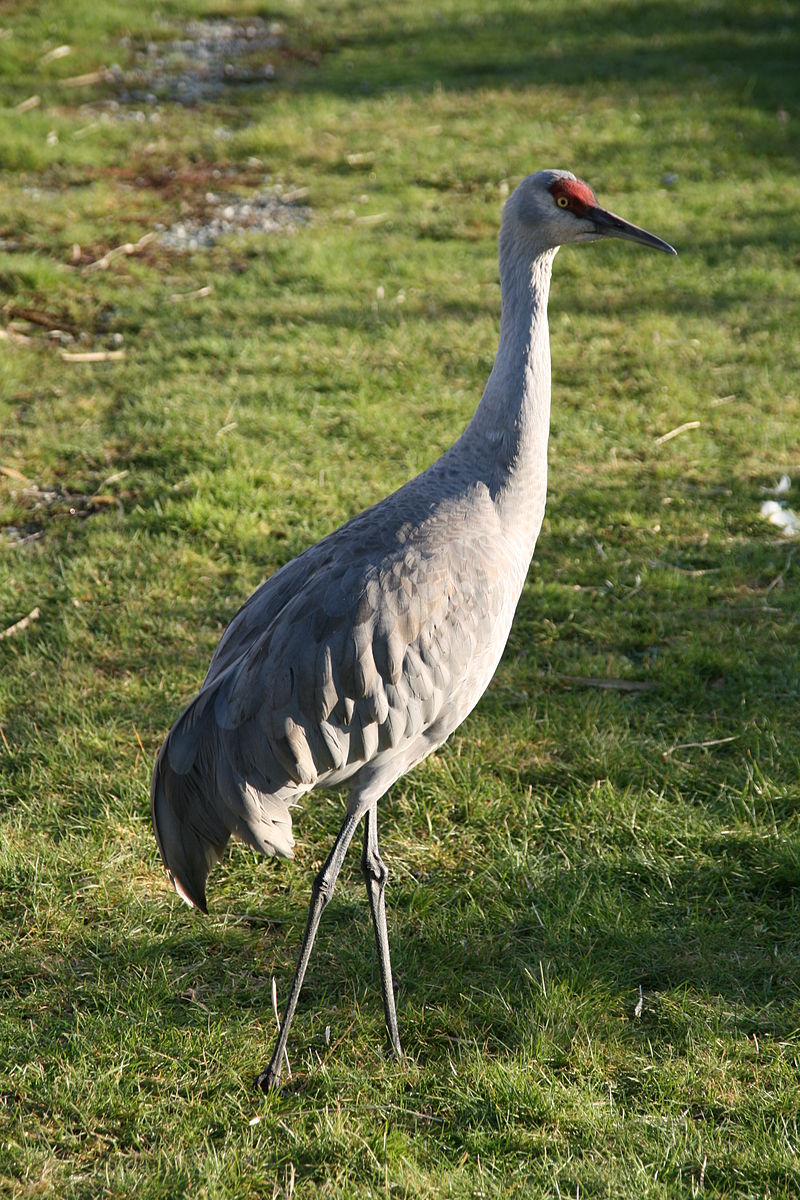
Wildlife biologist Dr. Robert L. Smith at West Virginia University states that descriptions and sightings of Mothman all fit the sandhill crane, a large American crane almost as high as a man with a seven-foot wingspan. The bird has circles of reddish coloring around the eyes. This particular crane isn't native to the region, but may have wandered out of its migration route at the time. 

In spite of this theory, Mothman sighting continue around the world to this day.


Photo courtesy of Jason W. via Flickr
So, what do you think? Was Mothman a sandhill crane, cryptid, or curse? My thoughts are that Mothman was a sandhill crane (which will disappoint my daughter immensely). But, like I said, I'm always game for a road trip.

Anyone up for Bigfoot?